The Ebola Crisis

The Ebola Crisis is a good case that shows 1) how we are all interconnected and 2) why we should care for our brothers and sisters.

1. We can pretend that we don’t know what’s going on or what’s happening to our brothers and sisters but it will eventually present itself at our doors. Our media had mentioned only a little about the Ebola crisis in Africa before it made it to the US. However, even with that little bit, we could have still rallied forth to do something to help. I’m sure there were probably some groups and organizations that tried to do something to help but by and large, the US did little to help. Some probably felt like, ‘Oh, it’s over there. What does that have to do with me?” You can keep telling yourself that only up until the moment you are faced with it directly, and then what…. So, if Ebola is over there then we don’t have to worry about it impacting our lives and we don’t even have to prepare for it.

You don’t even have to look overseas for examples. Right here in the US there are people being abused, mistreated, oppressed and yet we sit by and do nothing. “It’s not our problem.” “They brought it on themselves.” “They deserve it.” “I feel sorry for them but what can I do?” “It’s a shame they are doing that to those people.” Do any of these sound familiar? The time for burying our heads in the sand, or trying to isolate ourselves from the problems are over. It’s time for all people but in particular Christians to say enough! We are our brothers and sisters keepers. It does affect us. You don’t see the elevated crime rates? You don’t see the fluctuating state of our economy? You don’t see the children and young adults who feel as if they’ve been abandoned yet again. Well, keep ignoring the situation and you will.

2. Why should we care for our brothers and sisters? Why is that so important? The South African concept of Ubuntu, social unity and generosity of spirit, is widely known here in the US but only practiced sparingly. A society does better when it cares for its entire people. When all have the necessities, then everyone is contributing to the benefit and growth of society. We seem to think that if we spend money to help people, that it’s wasting our money. However, it’s actually the best way to spend money – investing in people. Otherwise, we will be investing in prisons, medicines, and other negative expenditures. Looking at the Ebola crisis, we see that when we don’t care for some and think it doesn’t matter to us, then we are living irrationally. To think that we can ever be isolated from the problems and woes of our brothers and sisters is ludicrous. It will impact our lives and families one way or another. However, if we collectively reach out to the hurting, sick, lost or oppressed, we can aide in their successes in life, which will ultimately help our own successes. Had we collectively reached out to Africa when Ebola was first found, then we could have worked together to minimize the deaths and spread of it. The thinking that one life is less important than another and therefore disposable goes against the whole concept of Ubuntu and, I believe, God.

So, with all this in mind and this model of the Ebola crisis:
Look anew at what’s going on in the world, Israel, Palestine, Middle East, Africa, Asia, etc.
Look anew at what’s going on in the US and all the senseless killings by police and other racists. Look anew at the attempts to suppress voters from exercising their right to vote
Look anew at how separated and disjointed our country has become, racially, economically, etc.
Look anew at the unequal education system, judicial system, housing system, etc.
Look anew and begin to talk with those in your community (whether they look like you or not, whether they think like you or not, whether they have as much as you or not, etc.) about possible things that can be done by you individually and you as part of a group.

A good place to start for resources, suggestions, etc. is your local place of faith – Christian, Muslim, Jewish, etc. They will typically have some working knowledge of who the organizers and workers are in the community on the different issues. You can also search the internet for nonprofits, community development groups, outreach and community centers, etc. I would not limit my online search to the local area because you can get great general information that can be applied locally.

I’d love to hear back from you about what you did and how you felt when doing it.
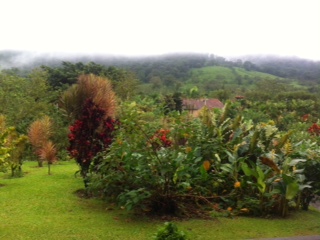
Beautiful Diversity!

27 Arenal Kioro View 4

While on vacation in Costa Rica (which is BEAUTIFUL!!!!), I was inspired by this view from our hotel room to write this poem.

Allow – Ask – Do

Nature is so beautiful and peaceful, something that cannot be packaged, bought or sold.
It soothes my heart and spirit and does miraculous things in my soul.
The refreshing rain intermittently comes to cleanse the earth and cause more growth as a whole.

The rich and different varieties of every color and hue, size and shape, texture and feel.
Amazing and inspiring as they all are interspersed on numerous hills.
Interacting and not, supporting and not, propping up, colliding yet all are still here.

Allowing for difference
Allowing for observing
Allowing for intrusion
Bending and touching as they will.

Oh, that we humans would take note and learn from nature.
Communities of diverse plants living together each individually yet so beautiful together.
Interacting, supporting, upholding, respecting and embracing one another.

Just like nature, we are different, distinct and yet come from the same source.
Each created by God to a particular time, place, race and purpose.
A people of God and if we are believers, then people of blessing and not curse.

Asking:
How can I help you today?
How can I ask God to bless you today?
How can I serve you today?
As God helps, blesses and serves me.

To get away is so important to do so we can relax and reflect.
Whether the leaving is mental or physical, it is something we should not neglect.
We will become more focused and purposeful in our talk; then our walk, it will affect.

As I’ve learned from a country of peace I, in turn, share this with you.
How refreshing and rejuvenating embracing peace can be if one embraces it true.
I vow to go home and do more to bring peace in all that I do.

Being peace in the midst of chaos.
Doing peace work at every opportunity.
Modeling and teaching peace to all I encounter…
To help bring peace to our world.

A Thought

“A thought:  Just because the people around you may allow you to be less than doesn’t mean you have to be that.  Push yourself to do better and be better and always be open to learning from ANYONE!!!!!”

I put the above message on Facebook.  It was for individuals but as I was reading this book, “Building A Discipling Culture,” it occurred to me that many churches have also chosen to be less than.  They don’t push themselves, their leaders or their members to do better and be better.  They do not possess a ‘discipling culture.’  

Building off the three main ways we learn (Classroom/Lecture passing on of information, Apprenticeship and Immersion), they say that in order for churches to create or build a ‘discipling culture,’ churches have to provide the information, imitate the process and allow for innovation.  They cite many instances in scripture where Jesus modeled this process for us but somehow we have mixed things up.  We don’t realize that “If you make disciples, you always get the church.  But if you make a church, you rarely get disciples.” (Mike Breen and the 3DM Team, Building A Discipling Culture, Second Edition, Pawleys Island, SC, 2011)

For those interested in creating and building a ‘discipling culture,’ this is a must read.

People of Blessing

This past Thursday, I attended a ‘Missional Forum’ put together by BODY | Oak Cliff.  The speaker was Fuller Seminary professor, Reggie McNeal and it turns out he and I have very similar thoughts about the state of the church today.  Two things I took away from the gathering were:

1.  As the people of God, we are to be a people of blessing.

2. We are to partner with God in his redemptive mission in the world and this means our lives are to be a mission trip – the way we live, how we treat people, who we engage, etc.

It was a good reminder for me at a time when I’ve been somewhat frustrated with churches and Christians.  Another reminder was a clip a friend sent me where they were testing to see if people would see the homeless people as they walked by.  In this clip, the ‘homeless’ people were the loved ones of the people walking by.  Yet no one noticed.  How I live my life, how I see and treat people, who I reach out to and seek to know, all say a lot about whether my walk and my talk are in sync, whether I am a person of blessing or not and whether I am partnering with God in His work or seeking to create my own.

Churches have somehow gone astray and don’t focus as much on living as Christ lived and blessing others. McNeal suggests that over the years we have some confused things and see going to church as the end point, not being the church. Being involves giving of ourselves, our time and our resources to help those in need of assistance and to reach out to those in need of a friend. So, at the end of each day, let’s reflect on whether we have been people of blessing and what more can we do the following day. Lord God, please bless us so that we can be a blessing to others and help in building your kingdom.

Diversify! Diversify! Diversify!

And no, I don’t mean your financial portfolio.  We like diversity and variety in a lot of things.  When going out, we like to go to a variety of places, doing different things.  It might be to the movies one time, out to eat, to the park, to the museum, etc.  We like to eat different types of food.  We would complain if every day we had to eat the exact same thing for breakfast, lunch and dinner.  We definitely like a variety of styles of clothing and even have them categorized; casual, business casual, semi-formal, formal, after five, etc.

I could go on and on about how we diversify our lives in so many ways.  So now, I would like to talk about how we diversify our financial portfolio.  We diversify so that we can have the greatest yields from our investments while minimizing the risks.  Risk and profit should be shared among a large group.  A typical portfolio will include 1) stocks, 2) bonds, and 3) short term investments.  Stocks have the highest risks but also the highest rewards.  Bonds have lower risk, so lower rewards but are more predictable.  Short term investments have the least risk (such as money market funds) and yield the least return but are the safest.

We could compare this to diversifying our congregations.  The higher risk individuals to welcome into our congregations would be the ‘other’ who is not a believer and is of a cultural group that our denomination has shunned or criticized in the past.  Those of lower risk would be the ‘other’ who is a believer yet also of a disparaged cultural group.  The least risky individuals are those like us but they are not welcoming to the ‘other.’

A friend talks about a church that he belonged to that practiced radical hospitality.  It was an imperative to them that they welcomed all of God’s creation through their doors.  Amazing!  You’ll notice that I don’t speak about the returns or rewards in regards to diversifying our congregations.  That is because our job is to welcome people in and share the good news.  God gives the increase.  God provides the return.  In the end, the ministry yield is fruitful with a variety of fruits of all colors, types, sizes, tastes, etc.

So, I say:  Diversify!  Diversify!  Diversify!

Next Newer Entries